
As you planned for your new little one, you likely thought about their first bath, their first feeding, and even their first diaper change. But what you might not have considered is this milestone moment: the first time they pass gas. When the gas continues, you might be wondering if your baby’s gas is normal or if it’s a concern. In this article, we’re sharing more about the potential reasons for your baby’s gas, tips to help relieve infant gas, and signs your baby may need a little extra help and attention.
As always, before you make your formula choice or if you’re concerned about your baby, please reach out to your child’s healthcare professional for guidance.
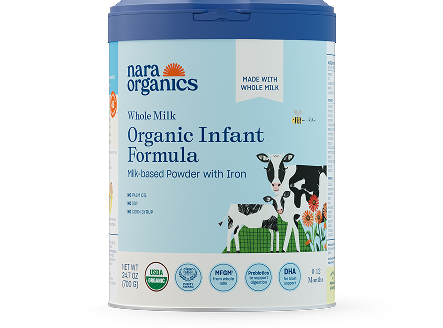
Nara Organics Infant Formula is designed to be easy on tummies. Our easy-to-digest protein blend is patterned after mature breastmilk with a 60:40 whey to casein ratio. We added organic GOS to our formula, which comes from organic lactose and serves as a prebiotic to support digestion and soft poops. Made with organic whole milk, Nara Organics also features the most whole milk of any U.S. infant formula.* Ongoing research shows that the components of milk fat globule membrane, found in our organic whole milk ingredient, can help nurture gut health.
*Nara obtained a new FDA clearance to be able to use the highest amount of whole milk (and therefore milk fat) in U.S. infant formula.
How can I tell if my baby has gas?
Passing gas, burping, and even spit-up may be some signs of a baby having gas. Gas can cause temporary discomfort in newborns, but it is usually nothing to worry about. It’s normal to have some gas, for infants and adults alike. But, for newborns who are still getting used to the sensation of gas and still working on the muscle coordination needed to pass gas, gas can make them a little uncomfortable. Babies who are gassy may also be fussy. They may grunt and squirm more than usual or lift their legs to their belly. They might scrunch up their face or get red in the face, and they may have a bloated belly.
What causes gas in babies? Why do babies have gas?
Passing gas is a natural body action that is the result of normal digestion. When babies drink breastmilk or formula, some of the nutrients in their digestive tract is broken down by normal gut bacteria. In this process, gas is produced as a byproduct of normal digestion – and after it is produced, it is passed.
Gas can also be the result of swallowing extra air. Babies can take in extra air when they drink (from a bottle or the breast), when they suck on a pacifier, and when they cry. Eventually, that extra air can come out as a burp or as a fart.
In some infants, certain types of foods may also lead a baby to have excess gas. Though uncommon, some infants may have issues tolerating certain protein or carbohydrates found in breastmilk or infant formulas. If this is the case, the child’s healthcare professional may recommend alternatives for feeding, like a special diet for the mom (if breastfeeding) or a specialty formula for the baby (if formula feeding).
What can I do to help soothe my baby’s gas?
No parent wants to see their baby uncomfortable with gas! If you notice that your baby seems gassy, introducing some techniques to help relieve gas is worthwhile. Here are some common tips recommended by some pediatricians and health experts.
Gas relief tips for all babies:
Feed your baby as soon as you notice they are hungry. When your baby is overly hungry, they may swallow extra air as they signal to you through crying that they’re hungry. They may also take in extra air if they are eating quickly. When you notice that your baby becomes ready for a bottle, feed them soon instead of waiting until they’re overly hungry.
Burp your baby, if they need it. Burping your baby allows them the chance to let out some extra air, so you can try to burp them before, in the middle, and after a feeding. However, some infants feed well without the need to pause for burping – and for these babies, interrupting a feed could lead to increased fussiness and tighter latch, which can result in additional air intake.
Try more tummy time. Supervised tummy time can be helpful for relieving gas, but it should only be done when the baby is not actively feeding or immediately after a bottle.
Bicycle your baby’s legs. Lay your baby on their back - or propped up on an incline using your knees - and gently move their legs in circular, bicycling motions. Or, try bringing their knees to their chest to help them get more movement and release gas.
Try massaging your baby’s tummy. Massaging your baby’s belly with light pressure in a clockwise direction may help get gas moving.
Consider over-the-counter gas-relief products for infants. After discussing options with your baby’s pediatrician, gas drops (which contain simethicone) and probiotics designed for babies, may be an option for your baby. However, use them according to label instructions – and if they’re not effective for your little one, stop using them.
Gas relief tips for bottle-fed babies:
Choose the right nipple flow, if bottle feeding. Getting the right flow of breastmilk or formula through a bottle nipple can help reduce the amount of air a baby takes in during a feeding. If the nipple has holes that are too big (like in fast flow nipples), your baby may gulp more during feedings and take in extra air. On the other hand, if the nipple has holes that are too small (like in slow flow nipples), your baby may be sucking too hard, which can also draw in air.
Consider switching to an anti-colic baby bottle, if bottle feeding. These bottles are designed with special features like vents to help reduce the amount of swallowed air.
Adjust how you feed with paced bottle feeding. Paced bottle feeding is a type of responsive feeding method where the baby largely controls the pace of the feeding. To feed this way, keep your baby upright during a feeding with their head higher than their stomach, and hold the bottle horizontally so that your baby has more control over the pace of the feeding (and so that the liquid doesn’t drip too quickly into their mouth).
Allow your baby to take the nipple, instead of pushing or forcing the nipple into its mouth, and allow them to regularly take breaks. This type of feeding can help reduce the speed that your baby eats, and though more research is needed, it is thought to be associated with less swallowed air and more opportunities for the baby to burp – thereby reducing gas.
Talk to your child’s healthcare professional: If you are formula feeding and if none of the other strategies have worked, talk to your child’s healthcare professional about a specialized formula. Though uncommon, some babies may need a formula which offers reduced lactose, partially hydrolyzed (partially broken down) proteins, or extensively hydrolyzed (extensively broken down) proteins.
Gas relief tips for breastfed babies:
Check your latch, if you are breastfeeding. If you’re breastfeeding, ensure your baby has an effective latch. A visit with a certified lactation consultant may be worth it.
The food you eat doesn’t usually affect your baby’s gas. What you consume impacts the nutrient quality of your breastmilk, but for most people, the foods they eat aren’t going to impact their baby’s gas. If you are concerned, continue to include nutritious foods in your diet, keep a food log, and talk to a healthcare professional.
When should I worry about my baby’s gas?
If your baby is eating well, gaining weight appropriately, and passing soft stools (that are not bloody, white, or black), then gas by itself doesn’t necessarily mean that your baby has a problem. Most babies experience discomfort from gas throughout their first year, and most will not need to be seen by their pediatrician for gas alone.
Remember, forming some gas is a normal bodily function and the discomfort caused by it usually decreases over time. Although your baby may seem most uncomfortable with gas at around 6-8 weeks of life, it can improve by about the time your baby is about 3 months old. With this understanding of the causes of infant gas and tips to help support your baby with infant gas, you are on your way to helping your baby better.
But if you see the following in addition to your baby’s gas, contact your child’s healthcare professional immediately:
-
Your baby stops eating and refuses to feed.
-
Your baby stops pooping, or their poop is black or bloody.
-
Your baby is vomiting or spitting up forcefully.
-
Your baby doesn’t seem to be gaining weight.
-
Your baby is unusually fussy and can’t be comforted.
-
Your baby developed a new rash, hives, swelling or difficulty breathing, which can be signs of an allergic reaction.
-
You are concerned about your baby.
Remember, if you notice any change in your baby’s behavior that seems unusual, consult your baby’s doctor.
Wondering what other parents have to say about Nara Organics Infant Formula and how it impacts their baby’s digestion and gas? Take a look at our parent reviews.
Additional resources for parents
https://www.healthychildren.org/English/ages-stages/baby/diapers-clothing/Pages/Breaking-Up-Gas.aspx
https://www.chop.edu/news/health-tip/how-help-newborn-gas
https://www.childrens.com/health-wellness/how-to-help-newborns-with-gas
https://www.akronchildrens.org/inside/2023/06/25/3-ways-to-relieve-infant-constipation/