
Whether you're combo feeding, managing a low milk supply, or transitioning away from breastfeeding, choosing a formula can feel overwhelming. But you aren't alone! About half of U.S. babies drink formula by 3 months old and 75% of babies are drinking formula by 6 months old.
When parents start researching formulas, many have the same question: Which formula is most like breastmilk?
Infant formula has come a long way in replicating the nutritional profile of breast milk, but not all formulas are created equal. Knowing what to look for on a label, and why it matters, is the first step in choosing the right one. In this guide, we'll break down the key components that make a formula similar to breast milk and what to look for when you're comparing options on the shelf.
Here are the components of formula that matter most, and what to look for in each one.
Protein Ratio: Whey vs. Casein
The two types of protein found in both breast milk and formula are whey and casein, and the ratio between them can affect how easily your baby digests their feed. Whey and casein behave differently in a baby’s stomach. Casein forms a denser curd as the stomach acidifies, which slows protein digestion and gastric emptying, while whey produces less aggregation, hydrolyzes faster, and empties more quickly. This can translate into softer, more frequent stools with a whey-predominant formula and firmer, less frequent stools with casein-predominant formula.
In mature breastmilk, the protein breakdown is 60% whey and 40% casein, which is where the 60:40 ratio you'll see on some formula labels comes from. Nara's protein blend was patterned after that same ratio, supporting easy digestion and keeping things moving comfortably.
Whole Milk vs. Skim Milk as the Base
Fat makes up about 50% of the calories in breast milk and plays a key role in brain development, immune function, and overall growth. Most formulas are made with skim milk as their base, with vegetable oils added in to bring the fat content up to the level babies need.
Whole milk-based formulas start with a higher fat content which lowers the amount of vegetable oils needed. It also naturally contains Milk Fat Globule Membrane (MFGM), a nutrient found in breast milk that developing research suggests can boost cognitive development, strengthen the immune system, and nurture gut health. [Thongseiratch T et al. (2024), Ambrożej D et al. (2021)]
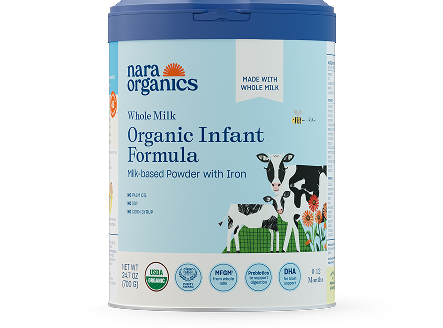
As an USDA organic certified whole milk formula with no skim, Nara prioritizes natural milk composition for a creamy formula that gives babies the fat they need.
Carbohydrate Source: Why Lactose Matters
Lactose is the primary carbohydrate in breast milk and provides energy for growth, supports calcium absorption for bone development, and can even help establish healthy gut bacteria.
Not all formulas use lactose as their main carbohydrate. Some substitute corn syrup solids, maltodextrin, or glucose syrup, which provide calories but don't offer the same functional benefits.
Just like breastmilk, lactose is the primary carbohydrate in Nara formula. Nara also adds organic GOS, a prebiotic derived from lactose, to further support digestion, and doesn’t use corn syrup solids, maltodextrin, or glucose syrup.
Healthy Fats: DHA & ARA
DHA (docosahexaenoic acid) and ARA (arachidonic acid) are long-chain polyunsaturated fatty acids found naturally in breast milk. These healthy fats support brain development, eye health, and immune system maturation, which is why they’re now added to most infant formulas. In randomized trials, infants fed formula containing both DHA and ARA showed immune markers closer to those of breastfed infants and a reduced risk of allergic disease and respiratory illness in early childhood. [Miles et al (2021) , Lewis et al (2016)]
When evaluating a formula, look for both DHA and ARA on the label rather than DHA alone.
Both DHA and ARA are present in breast milk, and the evidence supports adding them together rather than DHA alone. In the DIAMOND randomized trial, supplementing DHA at higher doses without enough ARA actually reduced infants’ blood ARA levels and dampened the cognitive benefit seen at more balanced doses — suggesting that the balance between the two matters, not just the amount of DHA. This is also why CODEX guidelines also recommend ARA to be present at levels at least equal to DHA when DHA is added to infant formula. [Colombo J et al (2017)]
Prebiotics & HMOs
Breast milk contains human milk oligosaccharides (HMOs), prebiotics that feed beneficial bacteria in your baby's gut and support immune development. When evaluating a formula, look for added prebiotics. On a label, you might see these listed as galacto-oligosaccharides (GOS), fructo-oligosaccharides (FOS), polydextrose (PDX), or 2'-fucosyllactose (2'-FL).
Nara prioritizes these gut health benefits by adding organic galacto-oligosaccharides (GOS), a well-researched prebiotic that selectively feeds beneficial Bifidobacterium — the dominant bacterial group in the gut of breastfed infants. In randomized trials, infants fed GOS-supplemented formula showed significantly higher Bifidobacterium abundance and a Bifidobacterium/Lactobacillus pattern that more closely mirrored that of breastfed infants than non-supplemented formula did. [Matsuki T et al. (2016), Heppner N et al. (2024), Giovannini M et al. (2014)]
Summary: What makes a formula close to breast milk
Here's a quick guide on what to look for as you evaluate routine infant formulas.
Protein: 60:40 whey to casein ratio modeled after mature breastmilk, to support digestion.
Fat: Whole milk base, which means more milk fat and less oils. If the formula has no skim milk, that brings the milk fat percentage higher and the fat composition closer to breast milk.
Carbohydrates: Lactase as the primary carb, just like breast milk. Note, this is for routine formulas. Babies who need specialized formulas may not tolerate lactose and need an alternative carbohydrate.
DHA & ARA: These fatty acids are found in breast milk. Babies get the most benefit when DHA and ARA are added to formula together.
Prebiotics & HMOs: Breast milk contains HMOs, natural prebiotics. On formula labels, look for GOS, FOS, polydextrose (PDX), or 2'-fucosyllactose (2'-FL).
Every baby is different, and the best formula is the one that works for you and your baby. If you have feeding questions, your pediatrician is a great resource.
FAQ
What formula mimics breast milk the most?
No formula is an exact replica of breast milk, but formulas that most closely mirror its composition tend to have a 60:40 whey-to-casein protein ratio, lactose as the primary carbohydrate, a whole milk base, and added DHA, ARA, and prebiotics. Few formulas check all of these boxes.
Is formula harder to digest than breast milk?
Formula is not inherently harder to digest than breast milk. Every baby is different, and some infants have sensitivities to specific proteins or fats. If you notice any digestive symptoms that concern you, talk to your pediatrician.
What ingredients should you avoid in baby formula?
Corn syrup solids, glucose syrup, and maltodextrin are permitted ingredients in specialty infant formulas designed for babies with diagnosed lactose intolerance or cow’s milk protein allergy, where they serve as necessary alternative carbohydrate sources.
For routine formulas intended for healthy babies with no known feeding issues, however, these ingredients provide calories without the functional benefits of lactose. [AAP Committee on Nutrition, Koletzko S, Niggemann B, Arato A, et al]
Is lactose good in baby formula?
Yes, lactose is the carbohydrate naturally found in breast milk and is generally well-tolerated by infants. It supports calcium absorption, provides steady energy, and has mild prebiotic effects.

Cited articles
CDC NIS-Child, 2022 birth cohort, Aug 2025 update
Dietary Guidelines for Americans. Part D, Chapter 4: Duration, Frequency, And Volume Of Exclusive Human Milk And/Or Infant Formula Feeding
Descallar FB, et al (2024). Frontier in Nutrition. Investigation of the gastric digestion behavior of commercial infant formulae using an in vitro dynamic infant digestion model
Demmelmair, H et al (2018). Best Practice & Research Clinical Endocrinology & Metabolism. Lipids in human milk.
Thongseiratch, T et al (Nov 2024). Bovine Milk Fat Globule Membrane Supplementation and Neurocognitive Development: A Systematic Review and Meta-Analysis
Ambrożej D et al. (2021). Milk Fat Globule Membrane Supplementation in Children: Systematic Review with Meta-Analysis
Miles EA, Childs CE, Calder PC (2021). Nutrients. Long-Chain Polyunsaturated Fatty Acids (LCPUFAs) and the Developing Immune System: A Narrative Review
Richard C, Lewis ED, Field CJ (2016). Appl Physiol Nutr Metab. Evidence for the essentiality of arachidonic and docosahexaenoic acid in the postnatal maternal and infant diet for the development of the infant's immune system early in life
Birch, Eileen E et al. “The DIAMOND (DHA Intake And Measurement Of Neural Development) Study: a double-masked, randomized controlled clinical trial of the maturation of infant visual acuity as a function of the dietary level of docosahexaenoic acid.” The American journal of clinical nutrition vol. 91,4 (2010): 848-59.
Colombo, John et al. “Docosahexaenoic acid (DHA) and arachidonic acid (ARA) balance in developmental outcomes.” Prostaglandins, leukotrienes, and essential fatty acids vol. 121 (2017): 52-56.
Matsuki, T., Tajima, S., Hara, T., Yahagi, K., Ogawa, E., & Kodama, H. (2016). Infant formula with galacto-oligosaccharides (OM55N) stimulates the growth of indigenous bifidobacteria in healthy term infants. Beneficial Microbes, 7(4), 453-462.
Heppner, Nina et al. “Diurnal rhythmicity of infant fecal microbiota and metabolites: A randomized controlled interventional trial with infant formula.” Cell host & microbe vol. 32,4 (2024): 573-587.e5.
Giovannini, Marcello et al. “Prebiotic effect of an infant formula supplemented with galacto-oligosaccharides: randomized multicenter trial.” Journal of the American College of Nutrition vol. 33,5 (2014): 385-93
Koletzko, S et al. “Diagnostic approach and management of cow's-milk protein allergy in infants and children: ESPGHAN GI Committee practical guidelines.” Journal of pediatric gastroenterology and nutrition vol. 55,2 (2012): 221-9.