
The first years of a child’s life lay a valuable foundation for future health and wellbeing. Nutrition plays a profound role during this important time, supporting the development of cognitive, motor, and socio-emotional skills throughout childhood and adulthood. In this article, we’re sharing information about normal infant brain development and nutrients that support brain health and neurodevelopment.
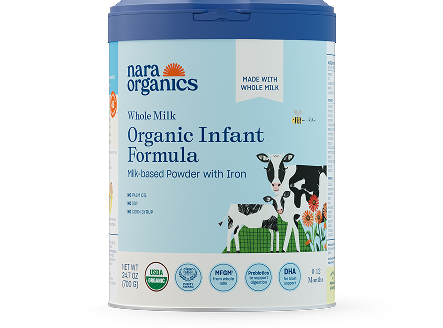
Creating Nara Organics Whole Milk Infant Formula took a lot of brain power! We spent 7 years developing Nara with scientists, nutritionists, and pediatricians in order to create an infant formula in the U.S. with the most organic milk fat possible (which took research, a new FDA designation, and a double-blind randomized controlled hybrid clinical trial). Nara Organics Infant Formula also includes DHA, ARA, inositol, and choline (all found in breastmilk) to support brain development.
The basics of brain development
The first 1,000 days of life, from conception to two years of age, are recognized as an important time for brain development.1 That’s because some of the most rapid brain development occurs during this time.1,2
The brain is a unique organ. It comprises multiple regions and processes, and each part has its own path and timeline for development.3 For example, one part of the brain called the hippocampus – which helps support recognition and spatial memory – begins growing rapidly at 32 weeks of gestation through about 18 months of age.1 The prefrontal cortex, which plays a role in attention and multi-tasking, begins its growth spurt during the first 6 months of age.1
The developing brain is shaped by early-life nutrition and experiences. While there are many nutrients that play a role in supporting normal brain structure and function, certain nutrients are especially vital.1
The role of breastmilk and infant formula in brain development
Breastfeeding and breastmilk are recognized as the optimal source of nutrition for infants, supporting bonding, brain maturation and infant neurodevelopment – and as an infant formula company, we support breastfeeding.2,4-7 If feeding breastmilk isn’t possible, an FDA registered infant formula is recommended in order to satisfy nutritional requirements in the first 6 months of life.8 Infant formula is highly regulated and is intentionally designed to resemble breastmilk as much as possible.9
To support brain development in infants, the American Academy of Pediatrics particularly emphasizes the importance of calories, protein, iron, zinc, choline, folate, iodine, long-chain polyunsaturated fats, and vitamins A, D, B6 and B12.8
Nutrients & components that support brain development
Protein
Macronutrients, including protein, are important in early childhood to help infants reach their full potential for healthy growth and development.10 In fact, the rate at which a baby grows in length (called the linear growth rate) , and adequate nutrition is important in order for babies to grow normally.11 Some studies indicate that malnutrition from not getting adequate protein or energy (calories) can negatively impact overall development, and in particular, the development of the brain and the nervous system.12,13
Nara Organics contains 2 grams of protein per 100 Calories, which meets the FDA’s requirements for protein in infant formula.
Carbohydrates
Carbohydrates are a major source of energy for a growing infant, and they are needed to support rapid brain development. The primary carbohydrate in breastmilk called lactose supports gut health by positively impacting the gut microbiota.14 Specifically, lactose supports the colonization of Bifidobacterium, a type of “good bacteria” which may support the gut-brain axis.15
Fats, essential fatty acids, DHA & ARA, and MFGM
Although carbohydrates are the brain’s preferred energy source, fats can also be used to supply energy to the growing brain. However, fat plays other important roles too in terms of brain and neural development.
For example, there are two essential fatty acids that infants need: linoleic acid (LA, an omega-6 fatty acid) and alpha linolenic acid (ALA, an omega-3 fatty acid). These fatty acids must be found in the diet, and they serve as the foundation for the body to make its own docosahexaenoic acid (DHA, an omega-3 fatty acid) and arachidonic acid (ARA, an omega-6 fatty acid), although this conversion is limited. DHA and ARA can be obtained from an infant’s diet, like in breastmilk, or infant formula with DHA and ARA added.
DHA plays a role in supporting the development of the brain, eyes, and nervous system.16,17 It accumulates rapidly in the brain and retina during the early stages of life.16,18-19 ARA supports normal brain development and a number of other functions, like immune response and cardiovascular function.20 Together, DHA and ARA comprise over 20% of the brain’s fatty acid content.4,21
Nara Organics Infant Formula contains DHA at a level of 20 mg per 100 Calories, and ARA at a level of 30 mg per 100 Calories. These levels are at expert recommended levels and also comparable to the average levels in mature global breast milk, and the addition of them to formula brings Nara closer to breastmilk.22,23,24
What’s extra special? A large meta-analysis published in 2025 indicated that the level of DHA/ARA at 0.5-1 can have a significant positive effect on cognitive development in infants.16 Nara Organic Infant Formula includes DHA and ARA at this level.
Milk fat globule membrane (MFGM) is a fat-containing part of breast milk and cows’ milk that contains beneficial lipid (fat) components like phospholipids, sphingolipids (including sphingomyelin), and glycolipids, which support brain function. For example, the sphingomyelin found in MFGM plays a role in the development of the myelin sheath, which is a protective layer surrounding parts of nerve cells that allow nerve impulses to travel rapidly.4,9
Nara Organic Infant Formula is based on organic whole cows’ milk, not skim milk, which means Nara contains naturally-occurring milk fat, a source of MFGM.
Phospholipids
The milk fat globule membrane (MFGM) is made up of numerous phospholipids, like phosphatidylcholine, phosphatidylserine, phosphatidylinositol, and as mentioned above, sphingolipids.25 These phospholipids, which are found in breastmilk and whole cow’s milk, play a role in supporting cellular function and the integrity of cell membranes. While the role of many of these lipid components and their significance to infant health continue to be investigated, what we know now is that the concentration of the phospholipids and sphingolipids in human milk fat is quite comparable to the concentration of these components in cow’s milk fat.26
Iron
Iron plays a key role in brain development, supporting the normal development of the architecture of the brain, myelination (where special cells wrap around nerve fibers to help speed up nerve signal transmission), and the development of the nervous system.1
Iron also transports oxygen to all parts of the body, including the brain. Iron deficiency anemia, due to iron deficiency, is a risk factor for cognitive impairment.27
Getting enough iron from the start is preferable compared to treating iron deficiency down the road. But getting too much iron may worsen neurodevelopmental outcomes.1, 28,29
At Nara, we include 1.2 mg of iron per 100 Calories, meeting US requirements for the amount of iron in infant formula.
Zinc & Iodine
Zinc is an essential trace mineral that is necessary for normal brain development because of its role in DNA and RNA synthesis.27 Although supplementation with zinc hasn’t been shown to improve cognitive development, a deficiency in zinc can result in poorer learning, attention, memory and mood.1,27
Iodine is an essential trace mineral that is needed in prenatal nervous system development in order to support the function of the thyroid hormone production, which produces hormones that drive brain development.
Choline
Choline is an essential nutrient that the body needs in order to make phosphatidylcholine and sphingomyelin, which are important for cell signaling. Adequate choline is important for the developing infant brain during pregnancy and infancy.27 For babies who aren’t eating solids yet, choline comes from breastmilk or infant formula.
Nara Organics Infant Formula includes choline at 20 mg per 100 Calories. This provides an amount similar to levels in breastmilk in order to support neural function.
Inositol
Research demonstrates that myo-inositol (a form of inositol, which is a sugar compound often called “vitamin B8”) supports brain development by playing a role in the formation of connections between neurons (nerve cells).30
Nara Organics Infant Formula includes 24 mg inositol per 100 Calories, which is similar to the amount found in mature breastmilk.
B Vitamins
Moms are encouraged to get enough B vitamins like folic acid and vitamin B12 during pregnancy in order to support neural tube development (the development of the brain and spine).27
After birth, B vitamins (like thiamin) play a role in metabolism, which support the brain’s supply of energy. B vitamins also help build the structure and function of membranes and synapses (junctions between two nerve cells) in the brain.27
Other factors shaping brain development
Aside from nutrition, reducing exposure to toxins is important for infant brain development.2 Learn more about Quality & Safety Testing at Nara Organics and how we test for contaminants.
In addition, enriching the child’s environment with experiences also impacts brain development.2 Parent-child interaction, physical activity, and sleep quality are all thought to be a factor in the development of the infant’s brain.31-33 Get tips published by the American Academy of Pediatrics on ways to play with your baby.
We thought a lot about brain health when developing Nara
Brains are complex, and so is infant formula! We thought a lot about brain health when developing Nara, and we factored in the evidence-based research on brain development when selecting the nutrients and ingredients to include in Nara Organics.
Remember, nutrition in early life shapes the developing brain and sets the stage for future health. And it’s not just one nutrient that impacts brain development, it’s many.